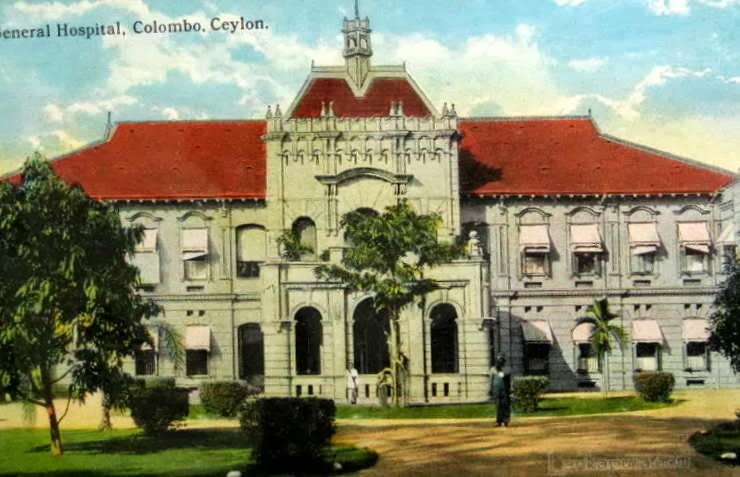
This blog is about the entrants in the year 1960, to the Faculty of Medicine, University of Ceylon, Colombo. The email address for communications is, 1960batch@gmail.com. Please BOOKMARK this page for easier access later.Photo is the entrance porch of the old General Hospital, Colombo, still in existence. Please use the search box below to look for your requirement.
Tuesday, February 23, 2016


Proven one-step process to convert CO2 and water directly into liquid hydrocarbon fuel
A team of University of Texas at Arlington chemists and engineers have proven that concentrated light, heat and high pressures can drive the one-step conversion of carbon dioxide and water directly …
http://flip.it/i5TJK
Monday, February 22, 2016
Ode to Joy, Beethoven
Flashmob
Flash Mob - Ode an die Freude ( Ode to Joy ) Beethoven Symphony No.9 classical
music
Ode
to Joy (English version)
Flashmob
Flash Mob - Ode an die Freude ( Ode to Joy ) Beethoven Symphony No.9 classical
music
Ode to Joy
From Wikipedia, the free encyclopedia
This article is about Schiller's poem. For the "Ode to Joy" theme by Beethoven, see Symphony No. 9 (Beethoven). For other uses, see Ode to Joy (disambiguation).

"Ode to Joy" (German: "An die Freude" [an diː ˈfʁɔʏdə], first line: "Freude, schöner Götterfunken") is an ode written in the summer of 1785 by German poet, playwright and historian Friedrich Schiller and published the following year in Thalia. A slightly revised version appeared in 1808, changing two lines of the first and omitting the last stanza.
"Ode to Joy" is best known for its use by Ludwig van Beethoven in the final movement of his Ninth Symphony, which does not set the entire poem and reorders some sections (Beethoven's text is given in that article). Beethoven's tune[1] (but not Schiller's words) was adopted as the Anthem of Europe by the Council of Europe in 1972, and subsequently the European Union.
Contents
[hide]The poem[edit]

Friedrich Schiller, who was enthusiastically celebrating the brotherhood and unity of all mankind, later made some small revisions to the poem when it was republished in 1803[citation needed], and it was this latter version that forms the basis for Beethoven's famous setting. Despite the lasting popularity of the ode, Schiller himself regarded it as a failure later in his life, going so far as calling it "detached from reality" and "of value maybe for us two, but not for the world, nor for the art of poetry" in an 1800 letter to his long-time friend and patron Christian Gottfried Körner (whose friendship had originally inspired him to write the ode).[2]
MOON RISE AT BYRON BAY
Do
explain how the moon outline is massive in relation to other seen objects! Is
it bursting?
jksw
The Most Beautiful Moonrise
On the 31st of July,
this beautiful time-lapse rise of the Full Blue Moon was captured 2 ½ miles
away from Cape Byron Lighthouse, on Belongil Beach, Byron Bay, New South Wales,
Australia. The head land and lighthouse at Byron Bay is the most easterly point
of the Australian Mainland and therefore is the first place in Australia to watch the full moon
rise. This video is made up of 1038 frames and slowed down to as close to real
time as possible. The photographer has been working on perfecting this type of
time lapse for over a year now after seeing the work of his favorite
photographer Mark Gee.
Don't forget to breathe watching this majestic time-lapse; everything about it is just perfect, and it's a photography clinic for anyone interested in taking time-lapse. See this stunning moonrise and appreciate just how beautiful God’s work can be.
► Probably The Most Beautiful Moonrise Time-Lapse You'll Ever See
Don't forget to breathe watching this majestic time-lapse; everything about it is just perfect, and it's a photography clinic for anyone interested in taking time-lapse. See this stunning moonrise and appreciate just how beautiful God’s work can be.
► Probably The Most Beautiful Moonrise Time-Lapse You'll Ever See
Subscribe to:
Posts (Atom)